
When monsoon clouds gather over India, homeowners know it isn’t just about cooler temperatures and greenery—it’s also the time when poorly installed windows reveal their worst flaws. You start noticing damp walls, peeling paint, and that dreaded musty smell. At the heart of most of these issues? Improper or absent Sliding uPVC Window Water Drainage.
A seemingly tiny design element, drainage holes in sliding window systems can be the difference between a water-tight home and a maintenance nightmare. At Magwin, we’ve seen firsthand how this often-overlooked detail has long-term consequences for structural integrity, insulation, and even health.
The Silent Enemy: Trapped Rainwater
During heavy rains, especially in cities like Dehradun, Nainital, or Pithoragarh, rainwater doesn’t just trickle down a window. It builds up. Without a proper Sliding uPVC Window Water Drainage design, that water gets trapped inside the window frame track. Once trapped, it seeks the nearest escape—often your wall plaster, insulation foam, or floor corners.
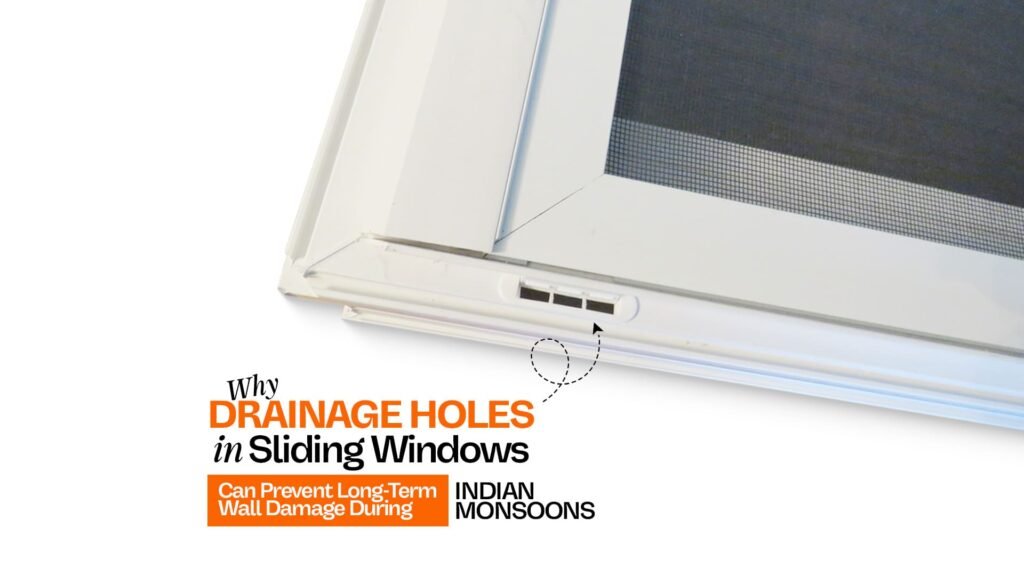
This may not be dramatic at first. But over seasons, it leads to damp spots, fungal growth, and weakened structural joints. Magwin installs a water drainage mechanism in every sliding window, allowing water to flow outward through precision-cut weep holes.
What Makes Drainage So Crucial in uPVC Sliding Windows?
uPVC profiles are non-porous and highly weather resistant. But that doesn’t mean water can’t collect inside the sliding tracks. This is especially true when the sill isn’t angled or when the profile design doesn’t incorporate internal water redirection.
Magwin’s engineers work with Encraft profile designs that ensure any rainwater entering the track is funneled through a concealed drainage path and exits via weep holes. These aren’t just holes drilled at random—they’re placed strategically to align with pressure differentials, air flow, and slope angles.
The result? Efficient Sliding uPVC Window Water Drainage that keeps internal spaces dry, even during relentless downpours.
Where Builders Go Wrong: Common Drainage Oversights
You’d be surprised how often we see homes with fancy sliding uPVC windows—but no drainage path. Sometimes the fabricator didn’t bother cutting weep holes. Other times, the installation team sealed the frame so tight with foam and silicone that any built-in drainage system got blocked.
That’s why Magwin insists on end-to-end control. We don’t just provide the profile—we fabricate, install, and inspect. Our team double-checks that every Sliding uPVC Window Water Drainage channel is open, angled, and functioning. No outsourcing. No shortcuts.
Real Talk: Indian Weather Demands Thoughtful Design
Unlike countries with consistent climates, India throws every extreme at your home—heat, dust, storms, and weeks-long monsoons. Especially in states like Uttarakhand, rain isn’t gentle. It’s heavy, frequent, and often accompanied by wind.
Magwin’s window systems are built for such unpredictability. Every Sliding uPVC Window Water Drainage feature is tested against water pressure, wind velocity, and air leakage standards. We also ensure that our installation teams in places like Sitarganj and Haldwani follow terrain-specific practices. What works in plains might not work on a sloped hill home.
Not Just Wall Damage—Drainage Affects Window Longevity Too
You might think the damage is limited to paint and plaster. But when water stagnates in your sliding tracks, it accelerates wear and tear. Dirt sticks to it, frames discolor, tracks rust (if any metal exists), and the sliding mechanism stiffens.
Magwin’s uPVC windows use SS 304-grade components that resist corrosion, but without proper Sliding uPVC Window Water Drainage, even premium parts suffer. Good drainage isn’t just about keeping your walls dry—it’s about keeping your windows smooth and functional for 20+ years.
How to Check If Your Sliding Window Has Proper Drainage
If you’re a homeowner or architect inspecting existing sliding windows, here are a few quick checks:
- Open the window and look at the bottom track. Are there small slits or holes at regular intervals?
- Pour a bit of water into the track. Does it flow out within seconds?
- From the outside, can you spot tiny holes near the base of the frame?
If you can’t find them, it’s time to call Magwin. We’ll assess your current setup and retrofit drainage if needed. Our window experts are trained to detect overlooked drainage problems in both new builds and renovations.
The Magwin Promise: Engineered for Rain, Built for Decades
Magwin doesn’t believe in off-the-shelf shortcuts. Every sliding window we design comes with concealed, performance-tested Sliding uPVC Window Water Drainage systems. Our in-house fabrication unit ensures we never miss a hole, seal, or slope.
In monsoon-prone towns like Mukteshwar or Ranikhet, clients often ask us, “Will these windows survive year after year of rain?” Our answer is simple: They don’t just survive. They thrive. That’s because Magwin’s window solutions are built with understanding, not just materials.
From Encraft profile engineering to Magwin’s hill-tested installation teams, everything works together to protect your interiors.
Final Thought: A Small Hole That Saves a Big Cost
It’s ironic—what looks like a flaw (a hole in your window frame) is actually what saves your walls, floor, and furniture from water damage. Drainage might be invisible, but its absence becomes all too visible.
That’s why Magwin treats Sliding uPVC Window Water Drainage as a priority, not an afterthought. Because in the battle between your window and Indian monsoons, smart design is your best defense.