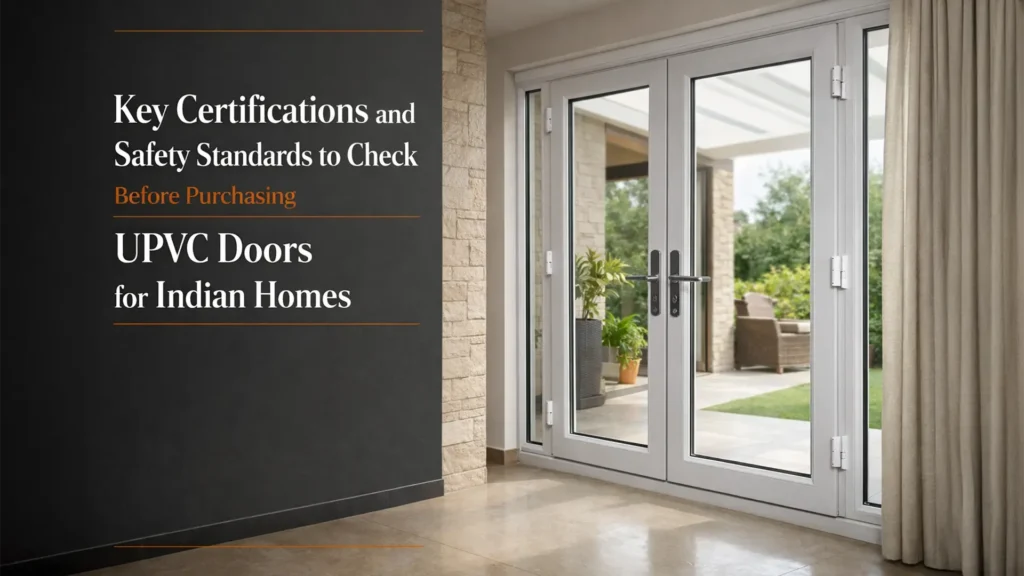
Modern uPVC double doors installed in an Indian home, illustrating compliance with uPVC door safety standards in India

Key Certifications and Safety Standards to Check Before Purchasing uPVC Doors for Indian Homes

We often obsess over the color, handle, or glass design of a door — but forget the one thing that truly matters: safety. For Indian homeowners investing in premium doors, especially in cities with extreme weather, pollution, and security concerns, compliance with the right certifications is non-negotiable.

Understanding uPVC Door Safety Standards India gives you the power to choose right — not just pretty. At Magwin, where every door is built for long-term durability and weather resistance, safety is not a feature. It’s a foundation.

Why Indian Homeowners Need to Demand Safety First

You’re not just buying a frame with hinges. You’re investing in thermal protection, intrusion resistance, wind pressure tolerance, and overall structural integrity. In regions like Uttarakhand, Delhi NCR, and Rajasthan, your door needs to survive both scorching summers and unpredictable monsoons.

Magwin ensures every uPVC door is fabricated as per international guidelines while meeting regional Indian construction expectations. And yes, that includes certifications that matter in the real world — not just sales brochures.

Key Certification #1: EN 12608 – Profile Quality Standard

This is the mother of all uPVC standards. EN 12608 sets benchmarks for uPVC profile composition, impact resistance, weathering, and dimensional stability.

Every Magwin uPVC door is manufactured using EN 12608–certified profiles. Why does this matter? Because poor-quality profiles bend, yellow, or crack over time — especially in India’s extreme sun and dust.

This EN 12608 tag ensures the door won’t just look new but perform like new, year after year.

Key Certification #2: RoHS Compliance – Health Comes First

RoHS (Restriction of Hazardous Substances) ensures no toxic elements (like lead or cadmium) are used in the making of your uPVC doors. It’s especially important in homes with children, pets, or the elderly.

Magwin doors are 100% RoHS-compliant. That means zero harmful emissions, zero health risks, and zero excuses. Your family’s safety starts at the door — quite literally.

This is a key checkpoint under uPVC Door Safety Standards India, but one that many skip asking for.

Key Certification #3: Fire Retardant Standards

In India, fire safety in residential doors is often overlooked — until disaster strikes. High-quality uPVC doors should pass flame resistance tests and self-extinguishing standards.

Magwin uPVC doors are fabricated using fire-retardant grade profiles that don’t drip, melt, or feed flames. That’s not a nice-to-have — it’s a life-saving difference.

Ask for documentation. If your vendor can’t show fire performance ratings, walk away.

Key Certification #4: SKZ Germany – Independent Quality Checks

SKZ is a global certifying body that tests uPVC systems for structural strength, weather resistance, and chemical integrity. SKZ-certified profiles undergo testing in real-world simulations.

Magwin partners with profile manufacturers that hold SKZ certifications — because you deserve doors built on verified performance, not assumptions.

This is especially important for Indian homes in areas with high rain, dust, and UV exposure. If you’re searching for reliable uPVC Door Safety Standards India, SKZ should be high on your checklist.

Key Certification #5: Wind Load Resistance

Your uPVC door must be rated to withstand the wind pressure of your specific geography. Coastal areas need higher ratings. So do high-rise buildings.

Magwin doors are tested for wind load performance and sealed to prevent air infiltration. You won’t see doors flying open in storms or leaking hot air in summers. This directly affects your electricity bills and home comfort.

All wind resistance metrics are shared in the Magwin quotation — and that transparency is part of our system-driven approach.

What Else Should Be in Your Safety Checklist?

Apart from major certifications, every Magwin door includes:


    • Multi-point locking systems with rust-free steel hardware

    • Double sealing for air, dust, and water protection

    • UV-resistant coatings that prevent fading or brittleness

    • Reinforcement with SS304-grade steel for high impact zones

    • No lead-based coloring agents in any part of the door

All of this — clearly documented, not verbally promised. That’s how Magwin operates.

Never Settle for Verbal Claims. Ask for Proof.

Ask your fabricator: “Can you show me the original EN12608 and SKZ certificates?”
If they hesitate, there’s your red flag. Many Indian uPVC dealers sell ‘equivalent’ systems that aren’t actually certified. At Magwin, there are no grey areas — only black-and-white documents you can see and verify.

Remember, true uPVC Door Safety Standards India aren’t just about ticking boxes. They’re about putting your home and family first.

Magwin: Building Doors That Meet Global Standards, Built for Indian Homes

Magwin doesn’t just make doors that look good — we make systems that perform under pressure. Whether it’s heat, dust, rain, or impact — every Magwin door is built to outperform expectations.

We’ve supplied uPVC systems across North India — from compact flats to large villas — always with documented certifications and transparent safety guarantees. No guesswork. Just good engineering.

Need a certified uPVC door that’s built for Indian homes?
📞 Call Magwin today: +91 7248-000121 and ask for our safety checklist.

Scroll to Top
Call Now Button