
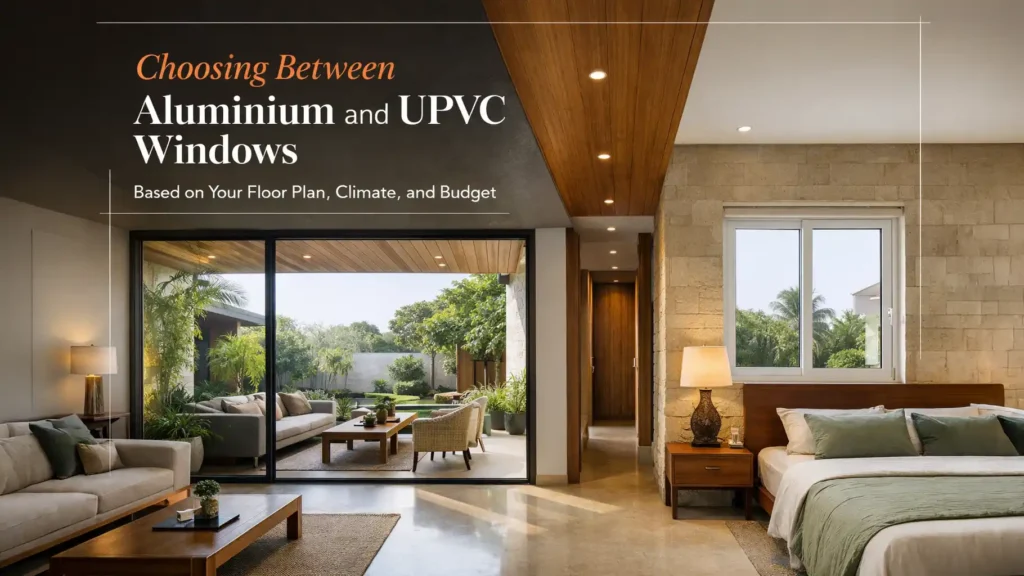
When it comes to choosing windows for your home, it’s not just about looks. Every decision — from the frame material to the finish — affects how your home feels, how much maintenance it demands, and how long it will perform. And in the current Indian market, the debate around uPVC vs Aluminium Windows India is stronger than ever.
Homeowners and builders alike are split between the clean lines of aluminium and the thermal comfort of uPVC. But the real choice isn’t as simple as aesthetics. The smarter question is — what works best for your specific floor plan, local climate, and financial priorities?
Let’s break it down, not with generic claims, but with a deeper, buyer-intent perspective that respects your investment.
1. Understand Your Floor Plan: What Does the Space Demand?
Your window material needs to match your layout. In smaller apartments or high-density urban homes, space is tight, privacy is essential, and energy efficiency matters. In sprawling villas or larger bungalows, aesthetic integration and structural flexibility may take precedence.
When comparing uPVC vs Aluminium Windows India, here’s how it plays out:
- uPVC windows offer better insulation and noise reduction — ideal for city homes or rooms close to traffic.
- Aluminium windows allow for slimmer frames and bigger glass areas, perfect for wide facades and panoramic views in luxury homes.
Magwin often helps clients visualize how each material integrates into their CAD layouts. Some projects even use a hybrid — uPVC in bedrooms, aluminium in living areas.
2. Match It to Your Climate Zone: Sunlight, Rainfall, and Temperature Swings
India’s climate isn’t uniform. From Delhi’s scorching summers to Kerala’s monsoons and Himachal’s winters, material performance varies wildly.
The uPVC vs Aluminium Windows India question gets clearer when you consider how each material responds to heat and moisture:
- uPVC has low thermal conductivity — it keeps interiors cooler and resists heat transfer. This makes it a winner for hot, dry zones like Rajasthan or central India.
- Aluminium, unless thermally broken, conducts heat easily — potentially increasing indoor temperature. But it resists corrosion, making it better for coastal areas if treated correctly.
Magwin uses German-engineered uPVC profiles with UV resistance and air-tight seals, which outlast typical aluminium systems in dust-heavy or extreme temperature zones.
3. Don’t Ignore Your Budget — But Look Beyond the Price Tag
Yes, aluminium can appear cheaper in some cases. But upfront cost isn’t the whole story. Long-term maintenance, energy savings, and repair costs can flip the equation fast.
Here’s how uPVC vs Aluminium Windows India stack up financially:
- Initial cost: Aluminium might be marginally cheaper depending on the system and supplier.
- Maintenance: uPVC wins — no rusting, no repainting, no warping.
- Energy efficiency: uPVC offers better insulation, leading to savings on cooling bills.
Magwin offers SS304-grade reinforced uPVC windows that retain performance even after 15+ years — a value few aluminium setups can match without premium-grade thermal breaks.
4. Consider Usage: Are These High-Traffic or Low-Use Windows?
For kitchen windows, bathroom ventilators, or storerooms, you may want something lightweight, low-maintenance, and rust-proof. For large balcony sliders or French doors, you want something structurally robust and elegant.
In this context, uPVC vs Aluminium Windows Indiais more about context than brand wars:
- uPVC is ideal for functional zones where insulation and cleanliness matter — like bedrooms, kids’ rooms, or bathrooms.
- Aluminium may work better for aesthetic openings where slim frames or colour customisation is critical — like balcony sliders or living room picture windows.
Magwin custom-fabricates both aluminium and uPVC windows based on room type, usage frequency, and customer intent — not just catalog sizes.
5. Aesthetics and Finish: What Look Are You Going For?
If you’re going for a minimalist, high-gloss modernist look, aluminium has the upper hand — especially with anodized or powder-coated finishes. But uPVC has come a long way. Today’s uPVC windows come in laminated wood finishes, matte greys, and textured whites that feel premium.
When it comes to uPVC vs Aluminium Windows India, here’s the aesthetic breakdown:
- Aluminium = urban, slim, industrial
- uPVC = clean, homely, versatile
Magwin helps homeowners see real-life samples before choosing — because a brochure image can’t show how sunlight hits a frame at 4 PM in your living room.
6. Frame Strength and Load Bearing: How Big Is the Window?
If your floor plan includes full-height windows or sliding units wider than 8 feet, aluminium’s inherent strength might help carry the load more easily. But today’s uPVC brands, especially those using SS304-grade steel reinforcements, can handle significant spans — provided the design is correct.
So in the uPVC vs Aluminium Windows India discussion, your fabricator’s capability plays a bigger role than the raw material. Magwin uses CNC-fabricated window systems that maintain dimensional integrity even on large spans.
7. Noise, Dust, and Seal Quality: Are You Near a Road, School, or Market?
This is where uPVC shines. Multi-chambered profiles, co-extruded gaskets, and tight tolerances mean that uPVC performs significantly better at sealing out dust and sound. It’s not even close.
If you’re choosing windows for a home near a highway or metro rail, uPVC vs Aluminium Windows India is an easy win for uPVC. Magwin’s soundproof uPVC window units, when paired with laminated glass, reduce noise by up to 35–40 dB — a lifesaver in noisy zones.
8. Lifecycle and Environmental Resistance: Will the Frames Last 15+ Years?
India’s environment is tough — from acid rain and dust storms to blazing UV and constant humidity. That’s why long-term weather performance is key.
Here’s how the two materials hold up:
- Aluminium may pit, fade, or oxidise over time — unless treated and cleaned regularly.
- uPVC is chemically stable, UV-resistant, termite-proof, and corrosion-proof.
In the uPVC vs Aluminium Windows India race, uPVC leads when it comes to lifecycle comfort. And with low maintenance, it’s a “set it and forget it” material.
9. What Does Your Local Fabricator Specialize In?
One of the most overlooked factors is fabricator expertise. Even the best material will fail if poorly installed. If your local vendor is an expert in one system but experimenting with the other, results can be disappointing.
Before choosing, ask:
- What system do you fabricate the most?
- Are you authorized by any system provider (like Encraft)?
- What references or real projects can you show?
Magwin is an Authorized Encraft Partner and offers both uPVC and aluminium window fabrication — with system engineering, installation training, and site-level QA. This ensures no matter which material you choose, performance isn’t left to chance.
The Verdict: Not Either/Or — But What’s Right for You
The uPVC vs Aluminium Windows India debate isn’t about which is better in general — it’s about what’s better for your floor plan, climate, lifestyle, and vision. Both have pros and cons. But the wrong decision, or worse — a poorly fabricated window — can undo your investment. That’s where Magwin steps in. With a full-service window planning, fabrication, and installation approach, Magwin helps you choose smarter, design better, and install once for decades.