
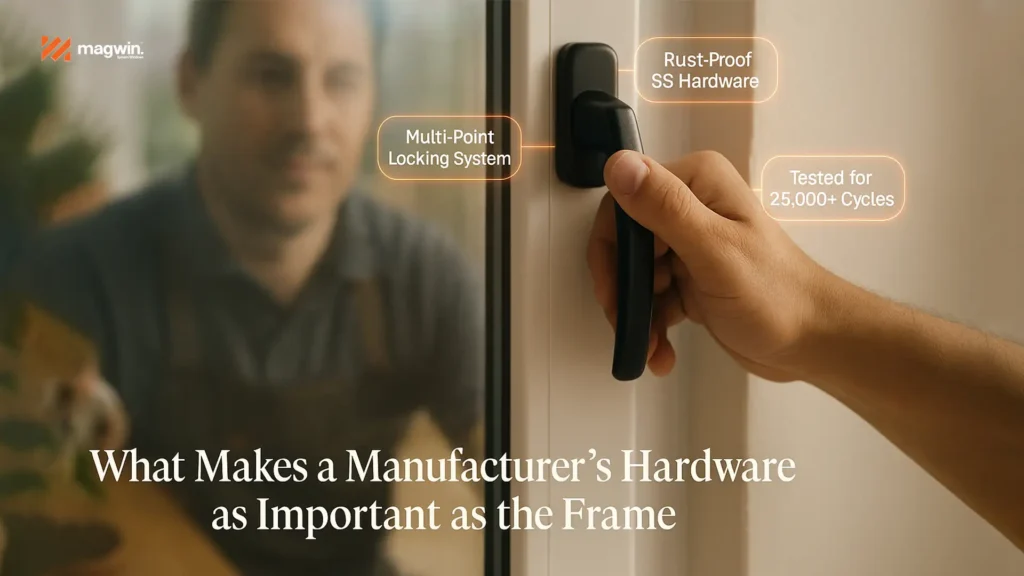
When we talk about windows and doors, the conversation often starts and ends with the frame—its thickness, its profile brand, or whether it’s reinforced. But what often gets overlooked is the very system that makes the window work every day: the hardware.
From the locks and handles to hinges, rollers, and fasteners, the hardware determines how secure, smooth, and durable your windows and doors really are. Even the strongest uPVC or aluminum frame will underperform—or worse, fail—if paired with substandard hardware.
At Magwin, we’ve learned that hardware isn’t just an accessory—it’s half the system, and it’s treated with the same engineering focus as the profile and the glass. As the Best Windows and Doors Manufacturer in Uttarakhand, we believe true quality lies in how the frame and hardware work together as a complete unit.
In this blog, we’ll explore what makes hardware such a critical component in manufacturing and why it should be a core consideration in your next window or door project.
Understanding the Role of Hardware in Window & Door Systems
Hardware refers to all the functional components that help a window or door open, close, lock, seal, and glide. This includes:
- Hinges
- Locks and handles
- Multi-point locking systems
- Friction stays
- Rollers and tracks (for sliding systems)
- Stopper mechanisms and limiters
- Fasteners, screws, and reinforcement brackets
Together, these parts define whether a system is:
- Easy to operate
- Resistant to wear
- Safe against intrusion
- Airtight and watertight
- Capable of handling glass weight and wind pressure
In other words, a premium frame with poor-quality hardware is like installing a luxury car engine with bicycle brakes—it simply doesn’t perform as expected.
Why Hardware Matters Even More in Uttarakhand
Uttarakhand’s diverse geography presents unique challenges for fenestration systems:
- In the hills, wind pressure, temperature variation, and moisture exposure test the limits of mechanical components.
- In the plains, high humidity and dust call for corrosion-resistant and smooth-gliding mechanisms.
- Across all elevations, daily wear and seasonal expansion-contraction can strain poorly chosen or poorly installed hardware.
For windows and doors to last 15–20 years in such conditions, their hardware must be:
- Structurally strong
- Weather-resistant
- Corrosion-proof
- Engineered for weight and pressure
- Compatible with reinforced profiles
That’s why manufacturers like Magwin choose hardware as carefully as they select frame materials—because a failure in one part compromises the whole.
The 5 Functions That Rely Entirely on Hardware
Let’s break it down further. There are five critical performance areas in any window or door—and all of them depend on high-quality hardware.
1. Smooth Operation
From sliding doors to casement windows, the feel of opening and closing depends on the alignment and precision of hinges, rollers, and friction stays.
Poor hardware = stiff, jerky, or squeaky motion
High-quality hardware = effortless, silent operation
2. Security
Multi-point locking systems, secure fasteners, and reinforced brackets are what keep your home protected.
Poor hardware = weak locks, easily tampered
High-quality hardware = tamper-proof, child-safe, and consistent over years
3. Weather Sealing
Hinges and locks determine how tightly a window or door seals. This affects insulation, soundproofing, and leak prevention.
Poor hardware = loose sealing, air gaps, and rattling
High-quality hardware = compression sealing that keeps elements out
4. Weight Handling
Heavy double-glazed panels or large sliding doors need precision-balanced hinges and rollers.
Poor hardware = sagging doors, misalignment over time
High-quality hardware = stable, balanced movement regardless of size
5. Longevity
Quality hardware is made from rust-proof materials like stainless steel or coated zinc alloys, which are vital in regions with rain and temperature swings.
Poor hardware = rust, breakage, discoloration
High-quality hardware = looks and works the same for years
What Defines Good Hardware? A Manufacturer’s Checklist
Any reliable manufacturer, especially one offering long-term warranties, must ensure their hardware ticks these boxes:
| Criteria | Importance |
| Material | SS304 or zinc alloy to prevent corrosion |
| Load Capacity | Rated to handle sash size and glass weight |
| Finish Quality | Powder-coated, anodized, or PVD-treated for aesthetics and durability |
| Cycle Testing | Hardware should survive 20,000–50,000 open/close cycles |
| Compatibility | Designed to fit the profile groove and reinforcement pattern precisely |
| Thermal Stability | Must function despite expansion/contraction in extreme climates |
| Locking Strength | Must pass impact and pull tests for security certification |
Magwin only partners with hardware brands that meet or exceed these parameters. Every hinge, handle, lock, and slider we use is selected not just for fit, but for function under real-use conditions.
Sliding vs. Casement vs. Tilt-Turn: Hardware Systems Compared
Different window and door types need very different hardware. A quality manufacturer adapts hardware systems accordingly.
🔹 Sliding Systems
- Require precision rollers with stainless-steel bearings
- Must include anti-lift locks for safety
- Track design must support smooth gliding and drainage
🔹 Casement Windows & Doors
- Depend on strong friction hinges that can handle wind load
- Use multi-point locking for sealing and security
- Hinges must support long sashes without sagging
🔹 Tilt & Turn Systems
- Require specialized gearboxes and pivot hinges
- Need tight-sealing compression locks
- Must support both inward swing and tilting action securely
Poor hardware in any of these categories can lead to mechanical failure or user dissatisfaction. Magwin ensures every product is hardware-optimized by design, not adjusted after production.
Hardware-Fabrication Integration: The Real Secret
At Magwin, we believe that hardware must be designed into the product—not added as an afterthought. That’s why we:
- Route exact placement channels during CNC cutting
- Install reinforcements at hardware anchor points
- Test movement and locking during post-fabrication inspection
- Use brand-specific jigs for handle and lock alignment
This integrated approach results in:
- Silent, fluid movement
- Tighter air sealing
- No rattle, wobble, or vibration
- Minimal maintenance over time
This is also why we’re widely considered the best windows and doors manufacturer in Uttarakhand—we fabricate with hardware in mind from the very beginning.
How Poor Hardware Affects Your Investment
| Symptom | Underlying Hardware Problem |
| Handle becomes loose | Fastener not anchored in reinforcement |
| Water leakage in slider | No drainage system or broken roller mount |
| Door drags on floor | Improper hinge strength or misalignment |
| Lock doesn’t align | Frame shift due to weak friction stay |
| Rattling window in wind | Loose hinge or low-torque screw |
Each of these can lead to costly repairs or complete replacements. That’s why choosing a manufacturer who takes hardware seriously isn’t optional—it’s essential.
Final Word: A Strong Frame Needs a Smart System
It’s tempting to focus only on profile brands or glass types when evaluating window and door systems. But unless they’re matched with premium, precision-fitted hardware, you’re not getting the full performance package.
At Magwin, hardware is part of our quality DNA. We don’t treat it as a secondary component—we treat it as half the product.
Because true durability doesn’t just come from strong frames.
It comes from systems that open, close, lock, and last—effortlessly.
📍 Visit Magwin Studios: Rudrapur | Haldwani | Nainital
📞 For Consultation & Hardware Demo: +91 7248-000121